Knex Coaster Instructions: A Comprehensive Guide
Welcome, coaster enthusiasts! This guide details building thrilling Knex roller coasters, from basic connections to replicating iconic designs like Dragon Fire and Yukon Striker.

Explore tire-drive systems, lift hill mechanisms, and advanced techniques for smooth, stable, and exciting rides. Detailed instructions and resources are provided for success!
Embark on a thrilling journey into the world of Knex coasters! These miniature marvels offer a fantastic blend of engineering, creativity, and physics, providing hours of engaging fun for builders of all ages. Knex construction sets, with their versatile rods and connectors, are uniquely suited for recreating the excitement of real-world roller coasters.
From simple, introductory designs to complex, gravity-defying structures, the possibilities are virtually limitless. You can meticulously replicate existing coasters like Canada’s Wonderland’s Dragon Fire or Yukon Striker, or unleash your imagination to design entirely original creations. The recent surge in online tutorials, including those on Instructables and YouTube, demonstrates the growing popularity and accessibility of this hobby.
This guide will equip you with the knowledge and techniques to build your own spectacular Knex coasters, covering everything from fundamental connections to advanced mechanisms like tire-drive systems and motorized lift hills. Prepare to learn, experiment, and experience the satisfaction of seeing your coaster come to life!
Understanding Basic Knex Connections
Mastering fundamental Knex connections is crucial for building stable and reliable coasters. The core of Knex construction lies in understanding how the various rods and connectors interact. The standard connector piece allows rods to be joined at various angles, forming the framework of your coaster’s track and supports.
Pay close attention to the ‘click’ sound – a secure connection is essential to prevent collapses, especially during testing. Experiment with different connector orientations to achieve desired curves and angles. Beyond the standard connectors, explore specialized pieces like angled connectors and wing connectors for increased design flexibility.
Understanding how to create strong, rigid joints is paramount. Reinforce critical connections, particularly those supporting significant weight or experiencing stress from the coaster car’s momentum. A solid foundation of basic connections will translate directly into a smoother, more exhilarating ride. Practice these techniques before tackling complex designs!
Essential Knex Parts for Coaster Building
Building impressive Knex coasters requires a strategic selection of parts. Beyond the standard rods and connectors, specific components are vital for functionality and design. Straight and curved track pieces form the core of the ride, while support beams provide necessary stability. Consider acquiring a variety of track radii for diverse layouts.
For lift hills, you’ll need gears, chains, and potentially motors (for motorized options). Tire pieces are essential for tire-drive systems, mimicking the launch mechanisms of coasters like the Neon Lightning. Specialized pieces like angled plates and wing connectors enhance structural integrity and design possibilities.

Don’t underestimate the importance of having a plentiful supply of basic connectors! Having extra parts on hand allows for experimentation and easy correction of design flaws. Investing in a Knex Education STEM Explorations Roller Coaster set provides a solid foundation of essential components.
Planning Your Knex Coaster Design
Before snapping a single Knex piece together, meticulous planning is crucial. Begin by sketching your coaster’s layout, considering the desired length, height, and features like loops and turns. Think about the overall theme – are you replicating an existing coaster like Yukon Striker or Dragon Fire, or creating an original design?
Determine the lift hill’s location and mechanism (manual or motorized). Carefully plan the first drop, as this dictates the initial speed and momentum. Consider the space available and the structural limitations of Knex. A well-thought-out plan minimizes frustration during construction and ensures a more stable, thrilling ride.
Visualize the track’s flow and identify potential problem areas. Remember that complex designs require robust support structures. Don’t be afraid to iterate on your design – sketching multiple versions can lead to a superior final product!
Building the Coaster Track
Track construction begins with establishing a solid foundation. Utilize a combination of Knex rods and connectors to create a smooth, continuous path for your coaster car. Prioritize stability; wobbly sections will derail your train. Begin with straight sections, ensuring consistent height and alignment.
Gradually introduce curves, using flexible connectors to maintain a fluid trajectory. Pay close attention to transitions between straight and curved sections – abrupt changes can cause the car to jump the track. Regularly test small sections as you build to identify and correct any issues.
Remember to account for the car’s weight and momentum. The track must be strong enough to withstand these forces. Consistent building practices and careful connector placement are key to a successful, rideable track.
Track Support Structures
Robust support is crucial for a stable and thrilling Knex coaster. The track’s weight, combined with the car’s momentum, demands a strong underlying framework. Begin by constructing vertical supports at regular intervals, using a combination of rods and connectors to create sturdy columns.
Connect these columns to the track with additional Knex pieces, ensuring a secure attachment. Triangulation is your friend – adding diagonal braces significantly increases the structure’s rigidity. Consider the height and length of your track; taller and longer sections require more frequent and substantial supports.
Don’t underestimate the importance of a wide base for each support column. This distributes the weight and prevents tipping. Regularly test the stability of the supports by gently applying pressure. A well-supported track is a safe and enjoyable track!
Creating the Lift Hill Mechanism
The lift hill is essential for providing the initial energy for your Knex coaster. Two primary approaches exist: manual and motorized. Manual lift hills rely on hand-cranking a system of gears or a simple winch to pull the coaster car upwards. These are simpler to build but require continuous manual operation.
Motorized lift hills, as seen in the Knex Neon Lightning coaster, utilize a motor to automate the ascent. A tire-drive system can be employed, using a rotating tire to grip and propel the car. Careful gear ratios are needed to balance speed and torque.
Regardless of the method, ensure a smooth and consistent ascent. The track angle should be gradual to prevent the car from stalling. Securely anchor the lift hill mechanism to the base to prevent unwanted movement during operation.
Manual Lift Hill Designs
Manual lift hills offer a straightforward entry point for powering your Knex coaster. A common design involves a hand-cranked gear system. Utilize various Knex gears to achieve a suitable gear ratio – a larger gear driving a smaller one increases speed, while the opposite increases torque, crucial for lifting the car.
Alternatively, a winch-style lift hill can be constructed. This involves winding a string or cord around a rotating axle, connected to a crank. The cord is attached to the coaster car, pulling it upwards as the crank is turned.
Stability is paramount. Securely mount the crank and gear system to a robust base structure. Ensure smooth rotation and minimal friction for efficient operation. Consider adding a braking mechanism to prevent runaway cars!
Motorized Lift Hill Options
Elevate your Knex coaster with a motorized lift hill for continuous operation! Several approaches exist, leveraging Knex motors and gear trains. A direct drive system connects the motor directly to a lift hill axle, offering simplicity but potentially lacking torque.

Gear reduction is key for increased power. Employing a series of gears – larger driving smaller – multiplies the motor’s torque, enabling it to haul the coaster car uphill. Experiment with different gear ratios to find the optimal balance between speed and lifting capacity.
The Neon Lightning coaster showcases a unique tire-drive system, utilizing a motor to rotate a tire that propels the car. Ensure secure motor mounting and a reliable power source. Safety features, like limit switches, can prevent overrunning.

Designing the First Drop
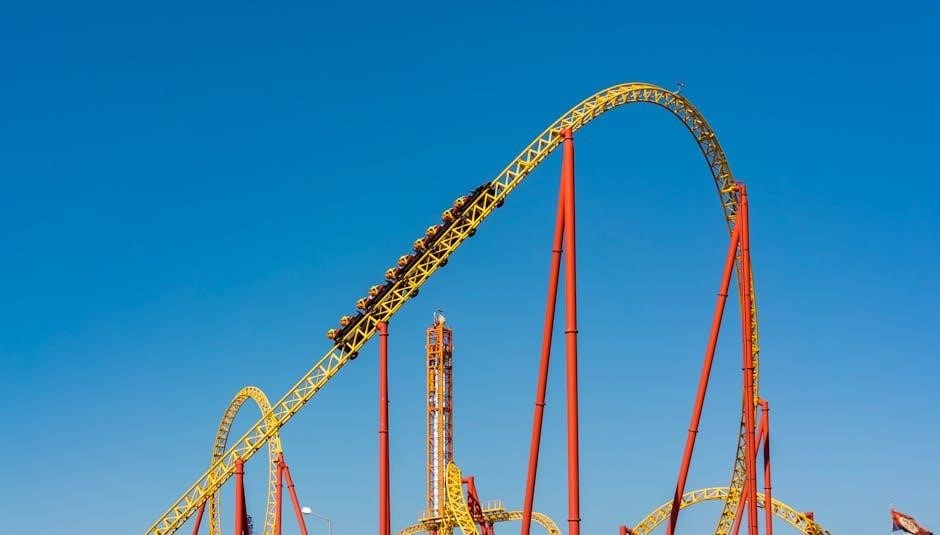
The first drop is the heart of any coaster, dictating initial speed and excitement! Careful planning is crucial for a successful descent. Begin by considering the height of your lift hill; a greater height translates to higher potential energy and faster speeds.
Calculating the drop angle is paramount. A steeper angle provides a more intense, immediate rush, but demands robust track support. A gentler slope offers a smoother transition, prioritizing stability. Experimentation is key to finding the sweet spot.
Smooth transitions are vital. Avoid abrupt changes in track angle, which can cause derailments. Utilize curved track sections to gradually ease the car into the drop. Reinforce the track at the base of the drop to withstand the increased forces.
Calculating Drop Angle and Speed
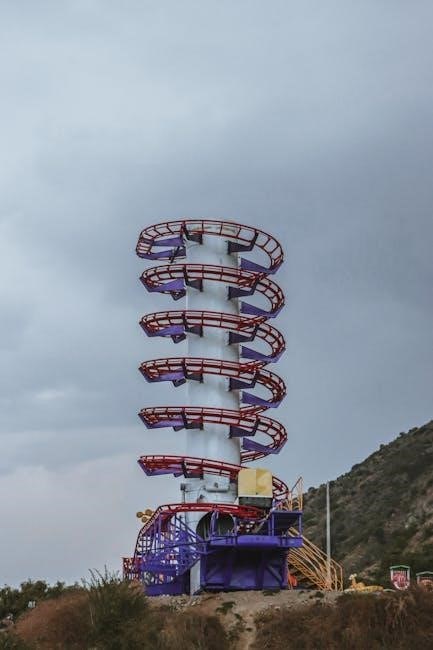
Precisely determining drop angle and resulting speed is fundamental to coaster design. While complex physics calculations exist, practical estimation works well for Knex coasters. A steeper drop (greater angle) yields higher speeds, but requires stronger support structures to manage the increased force.
Consider potential energy conversion: height x gravity = potential energy. This energy transforms into kinetic energy (speed) during the drop. However, friction from the track and car components reduces actual speed.
Experimentation is crucial! Test different angles and observe car performance. A gradual drop allows for smoother acceleration, while a sharp drop provides an immediate thrill. Observe for derailments and adjust accordingly. Remember, stability is paramount; prioritize a safe and controlled descent.
Incorporating Loops and Turns
Loops and turns add excitement, but demand careful construction for stability. Building stable loops requires a wide radius; tighter loops increase stress on the car and track, potentially causing derailments. Utilize robust support structures to counteract centrifugal force, especially at the loop’s apex.
Turns should be gradual curves, not sharp angles. Banking (tilting the track inward on turns) minimizes lateral forces, allowing the car to navigate smoothly at higher speeds. Experiment with different banking angles to find the optimal balance between speed and stability.
Reinforce connections within the loop and turns with extra Knex pieces. Test thoroughly, gradually increasing speed to identify weak points. Smooth transitions between straight sections, turns, and loops are essential for a thrilling, uninterrupted ride.
Building Stable Loops
Creating a structurally sound loop is paramount for a successful Knex coaster. Begin with a large diameter – wider loops are inherently more stable than tight ones. Utilize a circular base constructed from sturdy Knex rods and connectors to define the loop’s shape. Reinforce this base with additional supports radiating outwards, mimicking the supports found in real roller coaster loops.
Focus on secure connections; every joint must be firmly locked. Employ multiple connectors at critical points to distribute stress. Gradually build upwards, ensuring the loop remains symmetrical and doesn’t lean to one side. Test the loop’s integrity frequently during construction by gently applying pressure.
Consider adding internal bracing within the loop structure for enhanced rigidity. Remember, a stable loop is not just about the shape, but also the strength of its underlying framework.
Designing Smooth Turns

Smooth turns are crucial for maintaining momentum and preventing derailments in your Knex coaster. Avoid sharp, abrupt changes in direction. Instead, opt for gradual, sweeping curves. Utilize a large radius for your turns; the wider the turn, the smoother the transition will be for your coaster car.
Employ angled connectors to create a consistent curve rather than relying on forcing straight pieces into a bend. Support the outer edge of the turn with additional Knex structures to counteract centrifugal force. Ensure the track is level throughout the turn to prevent unwanted tilting.
Test the turn with your coaster car frequently, making adjustments as needed. A well-designed turn will allow your car to navigate the curve effortlessly, maintaining speed and stability.
Testing and Troubleshooting Your Coaster
Rigorous testing is vital before declaring your Knex coaster a success! Begin with slow, controlled releases of your coaster car to observe its behavior. Watch for any points of instability, derailments, or excessive friction. Common issues include track misalignment, insufficient support, and overly steep drops.

If the car stalls, identify the source of friction – often a tight bend or a poorly connected track segment. Adjust the track’s angle or smooth out connections. For derailments, reinforce the track supports and ensure the car fits snugly within the track’s path.
Experiment with minor adjustments to the track layout to optimize performance. Consistent testing and iterative improvements are key to a thrilling and reliable Knex coaster experience.
Identifying Common Issues
Several recurring problems plague Knex coaster construction, but are easily addressed with careful observation. Derailments frequently stem from track misalignment, insufficient banking on turns, or a car that’s too loosely fitted within the track. Stalling often indicates excessive friction, typically at connections or steep inclines.
Track instability is another common issue, manifesting as wobbling or collapsing sections. This usually requires reinforcing support structures or redistributing weight. Pay close attention to the lift hill mechanism; inconsistent power or mechanical binding can halt progress.
Finally, overly aggressive drops can overwhelm the car’s momentum, leading to stalls or crashes. Careful calculation of drop angles and consistent testing are crucial for identifying and resolving these issues.
Adjusting Track for Optimal Performance
Fine-tuning your Knex coaster is vital for a smooth, reliable ride. Begin by meticulously checking track alignment; even slight misalignments can cause derailments. Gently adjust connections to ensure a seamless flow, minimizing friction points. Banking turns slightly inward improves stability and allows for higher speeds.
If the car stalls, identify the obstruction – often a tight connection or steep incline; Experiment with different support structures to redistribute weight and reduce stress on critical sections. For drops, incrementally adjust the angle; steeper isn’t always faster!
Consistent testing is key. Observe the car’s behavior, noting any wobbles, stalls, or derailments, and make small, iterative adjustments until optimal performance is achieved.
Advanced Knex Coaster Techniques
Elevate your Knex coaster building with these advanced techniques! Explore tire-drive systems, inspired by the Knex Neon Lightning coaster, for motorless propulsion – utilizing friction for a unique launch experience. Mastering these systems requires precise alignment and tension adjustments.
Attempt replicating real-world coasters like Dragon Fire or Yukon Striker, demanding meticulous planning and structural integrity. These projects necessitate a deep understanding of physics and Knex construction principles.

Experiment with complex track layouts, incorporating multiple inversions and intricate turns. Reinforce structures with bracing and strategic connection points to withstand the forces generated during operation. Remember, patience and iterative design are crucial for success!
Tire-Drive Systems (Neon Lightning Style)
Unleash motorless power with a tire-drive system, mirroring the innovative design of the Knex Neon Lightning coaster! This technique utilizes the friction between a tire and the coaster car to initiate movement, eliminating the need for a motor. It’s a clever, engaging alternative.
Carefully position a tire piece strategically along the track, ensuring firm contact with the car’s underside. The station design is critical; a slight incline and precise tire placement are essential for a successful launch. Experiment with tire tension and track smoothness to optimize performance.
This system demands precise construction and adjustment. Minor tweaks can significantly impact the launch force. It’s a fantastic way to explore physics and engineering principles within your Knex creations!
Replicating Real-World Coasters (Dragon Fire, Yukon Striker)
Challenge yourself by recreating iconic roller coasters like Canada’s Wonderland’s Dragon Fire or Yukon Striker using Knex! This ambitious undertaking demands meticulous planning and attention to detail, studying blueprints and ride profiles is crucial.
Begin by scaling down the coaster’s dimensions proportionally. Focus on accurately replicating key elements – the lift hill, the first drop, loops, and turns. Utilize robust support structures to maintain stability, especially for taller models like Yukon Striker, the world’s tallest dive coaster.
Expect iterative design and adjustments. Replicating complex features requires patience and problem-solving skills. Online resources, like Instructables guides for Dragon Fire, can provide valuable insights and inspiration for your build!